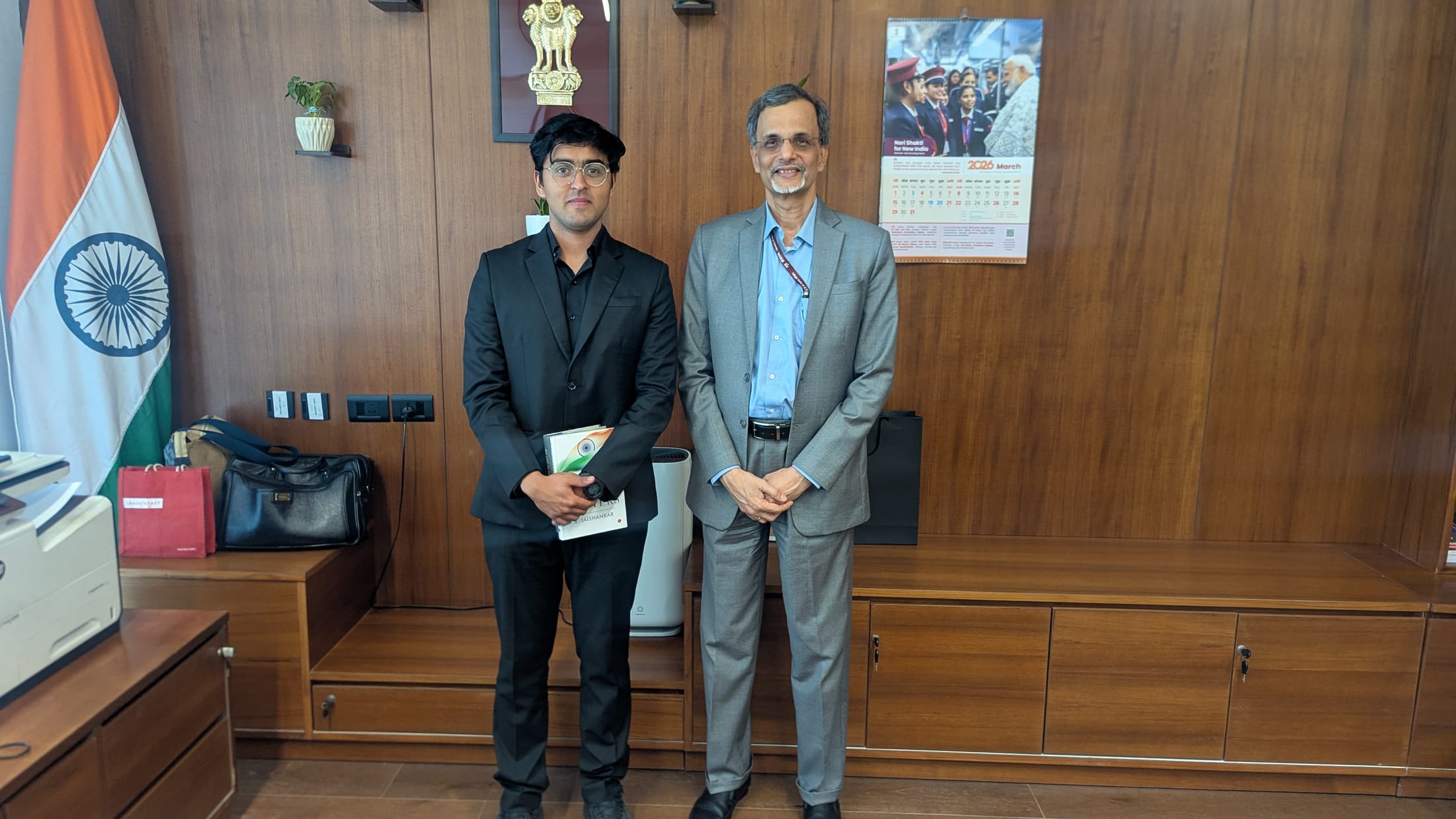
You may recognize the distinguished gentleman in the picture (no, not me) as Dr. V. Anantha Nageswaran, the Chief Economic Advisor of India.
I had an opportunity to spend a day with the CEA at Kartavya Bhavan in New Delhi. This was in March 2026, earlier this year - when the Strait of Hormuz was blocked, and alarms were going off across the world. I got to shadow him around across his work & meetings with important people, save for a couple high-clearance ones with Cabinet Ministers.
I’ve been following figures in the policy space and have taken a great interest in these roles. I would often speak about Dr. Raghuram Rajan’s writing (former CEA, former RBI Governor) in interviews - the role seems gargantuan, and therefore all the more exciting. I would write about that when applications ask me for my ‘long-term career goals.’ To make macroeconomic decisions, or inform decisions that affect over a billion people takes an astute understanding of the peculiarities of your market. So to meet a man of this stature was an immense honour.
I will stay away from specifics of what was discussed, macroeconomics or policy in this article. For I am not yet the most qualified authority to comment on how India should deal with these issues, and neither am I at liberty to. In this article I want to discuss the softer aspects of roles like these that are oft overlooked. This focuses on how conversations at the highest level happen & the kind of motion you need to be on at that level.
- What do high level advisors/diplomats/policy folks even do?
The CEA heads the Economic Division of the Department of Economic Affairs, led by different Secretaries and is under the Finance Minister.
The Economic Survey of India is one of their biggest annual undertakings, which informs and drives the direction of the Union Budget. The Union Budget itself is also a complex undertaking. The CEA role is ADVISORY, not EXECUTIVE - and so the duty focuses on providing robust analyses for informed decisionmaking.
- What does day-to-day look like?
Meetings, meetings, meetings. Like most upper management and policy roles, the CEA must interact and liase with all kinds of stakeholders: government ministries, private sector leaders, international investors, you name it. The CEA’s role is that of a Courtsman. To negotiate, manage expectations, while also not making the decisions fully on his own. It is his job to know every side of an argument before it happens, and to push for an outcome beneficial for the nation.
- How do conversations sound at the top?
Coming right out of B-School and proximity with the corporate world, I am only too well-adjusted to corporate nonspeak and MBAisms around me, where in order to appear intelligent, folks use big words and verbose placeholder metaphors which seldom convey any meaning at all.
“Let us circle back on that, and try to strike the right balance fundamentally to really double-click on the value unlocks that we’re overlooking from a 10,000 feet view for the nonlinear India 2 and 3 markets at the bottom of the pyramid that disproportionately slip through the cracks of our multivariate analysis.”
OR
“Does this help poor people?”
I bring this up because the conversations at the Ministry of Finance were FAR from it. Across meetings, the higher up we went in hierarchy, the more important a certain conversation got, the simpler it became. The language used was easy to understand and respond to. Jargon and unnecessary linguistic stilts were discarded in favour of incisive, clear conversation. Mind you, this does not detract from the level of polish or formality. Simple needn’t mean crude.
When the discussions are of such impact, one cannot afford to lose data in communication inside webs of verbosity.
I am all for detailed, creative communication - but it should be in service of deepening the point you’re making, or providing more nuance/information. The conversations I witnessed were great examples of this.
- What do you need to be good at, to be the CEA?
Dr. Nageswaran is a highly experienced, sharp man. When I asked him what skill has been the most important for him to cultivate in this role, he named two things:
- Building & Honing Perspective.
The CEA is an absolutely voracious reader. He is always reading to stay updated on what happens around the world, and how those shocks can affect his economy. He reads articles, blogs, opinion pieces, even analyzes unfiltered data. Dr. Nageswaran says no amount of reading is enough, and is constantly expanding his knowledge.
- Clarity of Thought
Dr. Nageswaran always pauses before he speaks - and everything he says sounds like it can be written in a book! In meetings he is astute and incredibly calm. His decades of experience give him a confidence that allows him to objectively analyze issues put before him. Writing is meaning making -
the CEA wrote a weekly column called Bare Talk for The Mint every Tuesday for 15 straight years from 2007 to 2022. This had a dual outcome - he honed his thought process and kept himself informed, while also soliciting opinions on his pieces, which were widely read by large figures in the space. Several conversations, agreements/disagreements, and counter-opinions were raised to him, and in the process, he saw more opportunities and learning by having increased his surface area.
I’ll remember this day fondly, for the amount of perspective it gave me. For the 1-on-1 advice and life philosophy that we discussed, and the realization that the world is run by folks just like you and I. (well, if you and I were a lot smarter, a lot more well-read and a lot more experienced - but you get my point.) Thanks a ton to my college for this opportunity, and a huge appreciation to Dr. Nageswaran for his guidance and grace.
Thanks for reading!